
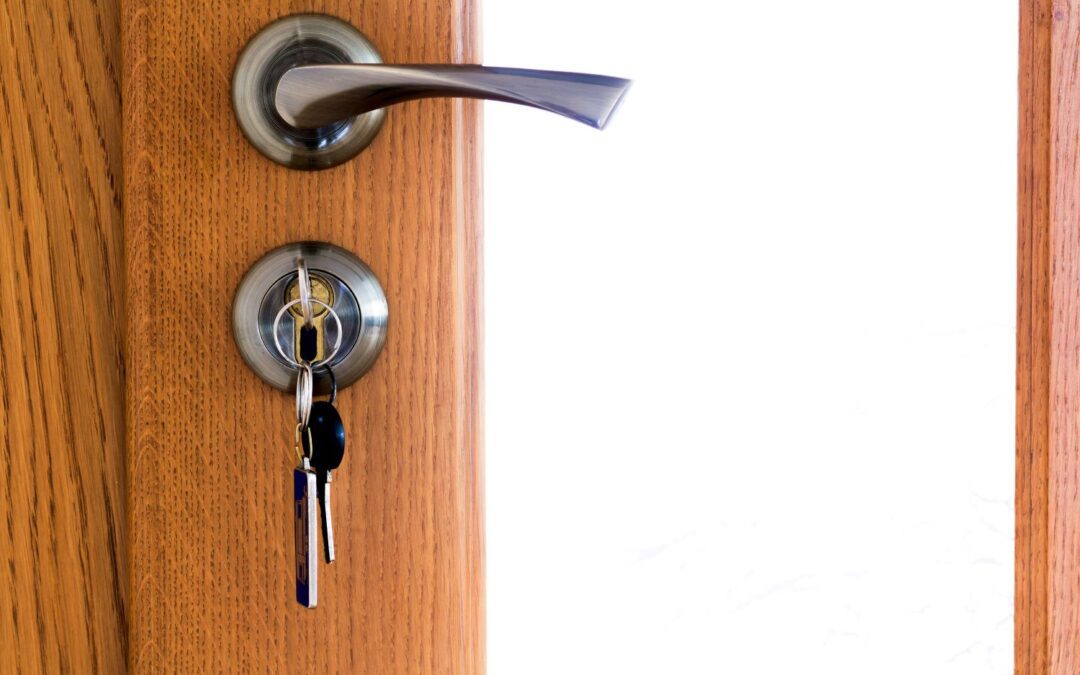
If your key turns but the door won’t open, the lock is not doing its job of pulling the latch back. Most of the time, the trouble is in three places, the cylinder, the linkage between the lock and the latch, or the handle set. You can do a few safe checks with a flashlight and a screwdriver. The goal is to find what is moving and what is not, without breaking the door or hurting your hand.
What is happening inside the door when the key turns
A door lock is like a relay race. The key turns the cylinder. The cylinder turns a tailpiece or cam. That motion moves the latch parts. Then the latch pulls back so the door can swing open.
When you turn the key and nothing opens, it usually means one of these is true:
- The key turns, but the cylinder is not grabbing the cam like it should.
- The cam turns, but the parts inside the lock are not passing that motion to the latch.
- The latch pulls back a little, but the door is still stuck to the frame because of pressure, sag, or a tight strike plate.
A good test is to listen. Is it silent, like the key is turning air? Or do you hear a solid clunk, like the latch tried?
Quick safety notes before you test anything
You do not need to be a superhero here. Keep it simple.
- Do not force the key. A snapped key is a bad day with extra steps.
- Keep fingers out of the latch edge when testing the latch. It can pinch.
- If the door is fire rated, often in apartments and many commercial units, do not modify the door or hardware.
- If you smell smoke or see heat damage, stop and call building staff or a pro right away.
Tools you can use for safe testing
You can do most checks with basic items:
- Flashlight or phone light
- Phillips screwdriver
- Flat screwdriver or a plastic card
- A dry lube made for locks, if you have it
- Pencil and paper to note what you find
Skip oil sprays that leave a wet mess. That sticky film can grab dust and gum things up.
Start with the simplest test, is the door under pressure
Sometimes the lock is fine. The door is just pushing hard against the frame.
Try this first:
- Push the door toward the frame while you turn the key.
- Pull the door toward you while you turn the key.
- Lift the door handle up a bit while turning the key, if the door has dropped over time.
If the door opens when you change pressure, the latch and lock might be okay. The issue may be alignment. This happens a lot after a long Houston summer when wood swells, or after heavy rain and humidity.
Weather tie-in for Houston
Heat makes materials expand. Humidity makes wood and some door frames swell. After a thunderstorm, a door that worked yesterday can feel like it gained ten pounds overnight. If you live near areas like The Heights with older homes, or near Westheimer where buildings see lots of daily use, you might notice this shift more often.
How to tell if the problem is the latch, not the key cylinder
Open the door if you can, then test the latch.
- With the door open, turn the key and watch the latch on the door edge.
- Does the latch pull back fully?
- Does the latch move but feel gritty or slow?
If the latch retracts fine when the door is open, but not when closed, the strike plate or alignment is likely the culprit. If the latch does not retract even with the door open, look at the cylinder, linkage, or handle.
If you cannot open the door at all, jump to the “If X, then Y” checklist later in this post.
Culprit 1, the cylinder is turning but not driving the lock
The cylinder is the part you put the key into. When it fails, it can feel like you are turning a knob that is not connected to anything. Like pedaling a bike with the chain off.
Common signs of a cylinder problem
- The key turns too freely with little resistance.
- The key turns farther than normal.
- You can turn the key both ways, but nothing changes.
- The key pulls out in odd positions on some locks.
Safe cylinder tests you can do
Test A, feel for normal resistance
Turn the key slowly. Compare the “feel” to another door, if you can. A normal lock has a smooth start, then a firm point where the latch begins to move.
Test B, watch the key angle
If the key can rotate past its usual stopping point, the cam or tailpiece may be loose or broken.
Test C, check for a loose cylinder (door open if possible)
If you can open the door, look at the screws on the interior side of the lock. Some hardware uses long through-bolts. If they back out, the cylinder can shift and stop engaging.
Safety note, if you remove screws and the lock falls apart, it can leave you stuck. If the door must stay secure, do not take the whole thing apart.
Why cylinders fail
- Wear from heavy daily use
- Key wear, a worn key can “sort of” turn pins but not cleanly
- Misalignment stress, when the door rubs the frame
- Moisture and grime inside the plug
Culprit 2, linkage trouble between the cylinder and latch
“Linkage” means the parts that pass motion from the key turn to the latch. In many locksets, the key turn moves a cam. The cam moves a bar or tailpiece. That then moves the latch.
If a small part cracks, you can get a perfect key turn with zero latch movement.
Signs of linkage problems
- The key turns with normal resistance, but the latch does not move.
- The inside thumbturn works, but the key does not, or the reverse.
- The exterior handle opens the door, but the key will not unlock, or it unlocks but will not retract the latch.
Safe linkage checks
Check A, compare both sides
Try the key on the outside and the thumbturn on the inside, if you can access both. If one side works and the other does not, the linkage on the failing side is suspect.
Check B, check for “half movement”
Turn the key while someone watches the latch edge. If the latch twitches but will not retract, a linkage part may be slipping.
Check C, listen for a click with no movement
A click can mean the cam is rotating, but it is not grabbing the tailpiece the right way.
Safety note, do not stick tools into the keyway to “help it catch.” That can bend parts and block the cylinder.
Culprit 3, the handle set is not pulling the latch back
Sometimes the key works. It unlocks. But when you pull the handle, the latch still stays out like a stubborn turtle.
That points to the handle or the spring return parts inside it.
Signs the handle is the main issue
- The key unlocks, but the door still will not open with the handle.
- The handle feels floppy, droopy, or loose.
- The handle does not spring back to center.
- You can push the latch in by hand, but the handle will not retract it.
Safe handle tests
Test A, try the latch directly
With the door open, push the latch in with your thumb. It should spring back out on its own. If it does not, the latch mechanism may be sticky or failing.
Test B, hold the handle up and try again
If lifting the handle makes it work, the handle return spring may be worn or the door may be sagging.
Test C, check screws
Loose screws on the interior side can let the handle shift away from the latch parts. Tighten gently. Do not over-tighten. You want snug, not “gorilla tight.”
If the key turns but the door won’t open, use this quick checklist
- If the key turns with almost no resistance, then suspect the cylinder cam or tailpiece is not engaging.
- If the key turns with normal resistance but the latch does not move at all, then suspect broken linkage inside the lock.
- If the key unlocks but the handle will not open the door, then suspect the handle set or latch retractor parts.
- If the latch retracts with the door open but not when closed, then suspect strike plate alignment or door pressure.
- If pushing or pulling on the door makes the key work, then suspect the door is binding from sag or swelling.
- If the lock works only sometimes, then suspect a loose screw, a worn key, or a latch that is sticking.
What we usually see in Houston, TX
In Houston, we see patterns that repeat like reruns.
- Humidity that makes wood doors swell and bind in the frame.
- Apartment and condo doors where the strike plate is a hair off after years of use.
- Storefront doors where the handle gets worn from lots of daily traffic.
- Deadbolts where the cylinder turns but the tailpiece slips after parts loosen over time.
If you are near neighborhoods like Midtown or The Heights, older door frames and settled buildings can add to alignment trouble, especially after wet weather.
Common myths and facts that can save you time
Myth: If the key turns, the lock is fine.
Fact: The key can turn while the cam, tailpiece, or linkage is failing.
Myth: More force will fix it.
Fact: Force often breaks keys, strips parts, and turns a small fix into a big repair.
Myth: Spraying oil into the lock always helps.
Fact: Wet sprays can attract dirt. A lock-safe dry lube is a better choice when lubrication is needed.
Myth: If the door is stuck, the lock is the only problem.
Fact: Door pressure, a tight strike plate, or hinge sag can stop a good lock from opening.
Alignment trouble, the strike plate and door sag issue
If the latch is working but the door still will not open, check the strike plate. That is the metal piece on the frame where the latch goes in.
Clues you have alignment trouble:
- Scratches on the latch bolt
- Fresh shiny marks on the strike plate
- The door needs a shoulder shove to close
Quick check:
- Close the door slowly and watch where the latch meets the strike plate.
- If it hits high or low, the door may be sagging or the strike plate may be off.
Safety note, do not file the strike plate unless you know the door type and fire rules. Many doors should not be altered.
When a stuck latch feels like a “lock problem”
A latch can stick from grime, wear, or a bent latch bolt. Houston humidity can mix with dust and make a paste inside moving parts.
Safe steps:
- With the door open, work the handle 10 times.
- If the latch feels rough, a small amount of lock-safe dry lube on the latch bolt can help.
- Wipe off extra. You want clean movement, not a slippery mess.
If the latch still sticks, the latch or lockset may need repair or replacement.
A simple care schedule that keeps doors working
This is not fancy. It is like brushing your teeth, but for your lock.
Weekly
- Turn the key slowly once, then fast once, to feel changes early.
- Make sure the handle returns to center and does not droop.
Monthly
- Check visible screws on the handle and deadbolt trim. Tighten gently if loose.
- Wipe the latch edge and strike plate with a dry cloth.
- If the door drags, note where it rubs.
Yearly
- Use a lock-safe dry lube in the keyway if the lock feels sticky.
- Inspect weather stripping. Swollen or torn strips can add pressure.
- Have a pro check alignment and hardware wear if the door gets heavy use.
When to stop troubleshooting and call a locksmith
Stop your testing and call for help if:
- The key is bending or you feel it might snap.
- The cylinder spins freely and you cannot secure the door.
- The door is a storefront or multi-tenant door where code rules apply.
- You see loose parts falling out of the lock.
- You are locked inside or locked out and need a safe entry plan.
A locksmith can test the cylinder, confirm if linkage is broken, and fix alignment so the door works without brute force. If you need help in Houston, you can reach Right Away Locksmith LLC at (832) 850-5261 or visit https://rightawaylocksmith.com. For service options, see Residential locksmith, Commercial locksmith, or Emergency locksmith. You can also use Contact Us to schedule help.
FAQs
Why does my key turn but the deadbolt will not unlock?
The cylinder may be turning without grabbing the cam or tailpiece, or the bolt is bound by door pressure. Try pushing or pulling the door while turning the key.
Can humidity make my door lock stick?
Yes. Humidity can swell wood and shift alignment. It can also add grime inside moving parts over time, which makes action feel rough. For general background on humidity, see https://en.wikipedia.org/wiki/Humidity.
Is it safe to spray WD-40 into my door lock?
Many general sprays leave residue that collects dust. A dry lubricant made for locks is a better pick if lubrication is needed.
How can I tell if it is the handle or the deadbolt?
If the deadbolt unlocks but the latch will not retract with the handle, the handle set or latch retractor is likely the issue. Test the latch with the door open.
Why does it work from the inside but not the outside?
That often points to linkage on the exterior side, a loose tailpiece, or a cylinder issue. Comparing both sides is a quick way to narrow it down.
What if the key turns only halfway and stops?
Stop forcing it. The key may be worn, the pins may be sticking, or the lock may be misaligned. Forcing can snap the key.
Can I remove the lock while the door is closed?
Sometimes, but it can go sideways fast. Screws can be blocked by the door frame, and parts can drop inside the door. If the door must stay secure, call a locksmith.
Should I replace the lock if this happens once?
Not always. A loose screw or alignment issue can mimic a bad lock. Testing the latch and door pressure first can save time.
Right Away Locksmith LLC helps homeowners, renters, and business owners in Houston, TX when a key turns but the door won’t open, whether the issue is the cylinder, linkage, handle, or alignment. We can pinpoint the cause fast, restore smooth operation, and help you avoid broken keys and damaged hardware. Call (832) 850-5261 or visit https://rightawaylocksmith.com to schedule help.
Additional reference: For general information about locks, see https://en.wikipedia.org/wiki/Lock_(security_device).